


Martin Armstrong, Gold, and the Myth of Perfect Market Cycles

The CIA, Socrates, Safra, HSBC, Prison, Gold, and the Dangerous Appeal of Forecasting the Future

The most gripping version of the Martin Armstrong story does not begin with a gold chart.
It begins with a computer.
According to Armstrong and his supporters, the real conflict behind his downfall was not simply a fraud case, not simply a failed investment structure, and not simply a fight over missing assets. It was about his forecasting system — the computer model later associated with the name Socrates.
In Armstrong’s version of events, his model had become too accurate, too valuable, and too interesting to powerful institutions. He claims that after his system anticipated major international events — including the Russian financial crisis — U.S. intelligence wanted access to the machine. In one of his own accounts, Armstrong says the CIA wanted him to build a computer for them, and that his refusal became part of the chain of events that led to the attack on Princeton Economics. This is Armstrong’s claim, not an independently proven fact, and it must be treated carefully. But it is central to the mythology around him.
Then there is the Safra connection.
Armstrong links his downfall to Edmond Safra, Republic National Bank, and the sale of Safra’s banking empire to HSBC. The connection between Armstrong, Republic, Japanese investors, Safra’s banking empire, and HSBC is not imaginary. HSBC’s own history states that HSBC acquired Republic New York Corporation and Safra Republic Holdings on December 31, 1999. The Guardian reported in 2001 that HSBC took a large legal charge after Japanese investors sued HSBC in connection with allegations involving Martin Armstrong, Princeton Global Investors, Republic, and billions of dollars of allegedly fraudulent bonds. The same report stated that the allegations surfaced after HSBC announced the takeover of Safra’s empire and that the issue helped reduce the acquisition price.
To prosecutors, the case was about fraud. The U.S. Attorney’s Office said Armstrong pleaded guilty in 2006 to conspiracy to commit securities fraud, commodities fraud, and wire fraud in connection with what prosecutors described as a massive Princeton Notes scheme. The CFTC later stated that Armstrong was serving a five-year sentence at Fort Dix after pleading guilty in that related criminal case.
But to Armstrong’s supporters, that official version misses the true center of gravity. They believe the battle was about the model, the computer, the banks, the records, and the question of who controlled the evidence. Armstrong has argued that Republic National Bank and Safra-related interests were central to the real story, and that the government relied too heavily on the bank’s version of events. Again, this is his claim; it is not the same as the official court record. But for understanding why Armstrong became such a powerful figure in the hard-money world, the claim matters.
This is why Armstrong’s story grips gold and silver stackers.
The precious-metals community is already skeptical of governments, central banks, commercial banks, fiat currency, and official narratives. Armstrong’s story has everything that audience finds fascinating: a self-taught forecaster, rare coins, gold, currency cycles, a secretive computer model, intelligence agencies, a billionaire banker, HSBC, Japanese investors, missing assets, prison, and the claim that markets can reveal political events before they happen.
That is a powerful story.
But power is not the same as proof.
A serious article about Martin Armstrong has to walk a narrow line. It must not flatten him into a cartoon villain, because some of his ideas about confidence, cycles, capital flows, and gold are genuinely interesting. But it also must not turn him into a prophet, because his legal history is serious, his claims are controversial, and the mythology around him can seduce investors into believing that markets can be timed perfectly.
That is the real subject of this article.
Not just Armstrong.
Not just gold.
Not just Socrates.
But the dangerous human desire to believe that somewhere, hidden behind the noise, there is a perfect market clock.
The Lebanon Story: The Forecast That Built the Legend
Before the CIA story, before prison, before Safra, before HSBC, and before Socrates became part of Armstrong’s modern mythology, there was another story: Lebanon.
According to Armstrong, one of the early events that shaped his reputation involved a dataset from the Universal Bank of Lebanon. In his telling, the bank had access to historical daily currency data going back into the nineteenth century and wanted to know whether a model could be built from the movements of the Lebanese currency. Armstrong says he built the model and that it projected a critical collapse point to the exact day: June 6, 1982.
That date matters. On June 6, 1982, Israel launched the invasion of Lebanon that became known as the First Lebanon War, or Operation Peace for Galilee. The war began after escalating violence and the attempted assassination of Israel’s ambassador to the United Kingdom, and Israeli forces crossed into southern Lebanon. The date is historically established, even if Armstrong’s claimed pre-war forecast is not independently verified in the same way.
For Armstrong’s supporters, the Lebanon story is proof that his system could read stress inside a currency before the political explosion became visible. It suggests that money itself carries information — that currency prices, capital flows, and confidence movements may reveal the condition of a nation before newspapers and governments admit it.
For skeptics, the story raises a different question: was this a documented forecast made before the event, or a retrospective legend built around a dramatic date?
That tension is exactly why Armstrong is useful for a serious gold article. His story captures both the attraction and danger of cycle thinking.
If a currency can warn of war, if capital flight can reveal political collapse, if gold can signal distrust in government, then a model that reads these patterns would be extraordinarily valuable. But if investors begin to believe every historical event can be reduced to a hidden cycle, they can slide from analysis into prophecy.
And prophecy is dangerous in markets.
From Coins to Cycles: Why Armstrong’s Background Matters
Martin Armstrong was not trained as a conventional academic economist. Biographical accounts describe him as having started young in the world of coins and stamps, later moving into commodities, currency analysis, and economic forecasting. That background is important because the coin world teaches lessons that ordinary finance often ignores.
Coins are never just metal. They are metal, history, scarcity, condition, story, premium, liquidity, and psychology. A rare coin can rise far above its metal value, then crash when the market changes. A gold coin can be both a monetary asset and a collectible. A silver coin can trade as bullion in one market and as numismatic history in another.
That kind of market teaches a person to think cyclically. Collectible markets boom and collapse. Bullion premiums widen and compress. Public taste changes. Confidence comes and goes. Buyers overpay in manias and disappear in downturns.
This is one reason Armstrong’s ideas appeal to stackers. He came from a world where money is physical, history matters, and price does not move in a straight line.
His famous idea is the Economic Confidence Model, often associated with an 8.6-year cycle, or roughly 3,141 days. Armstrong has described it not as a simple gold model or stock-market model, but as a global confidence model based on international capital flows. In his own explanation, a common mistake is assuming the model should directly predict one asset such as gold, when he frames it as a broader model of confidence and capital movement.
That distinction matters. If the model is about capital flows, then it may help explain why money moves from public assets to private assets, from one country to another, from bonds to equities, from fiat to gold, or from confidence to fear. But if a follower treats it as a perfect trading calendar, the model becomes something much more dangerous.
The Official Case: Fraud, Princeton Notes, and Prison
Now we have to separate mythology from the official record.
The official case against Armstrong was severe. According to public regulatory and legal records, Armstrong was accused in connection with the collapse of Princeton Economics and investment products sold to Japanese investors. The allegations involved investor money, hidden losses, false account statements, and the use of incoming funds to cover earlier obligations. The CFTC later stated that Armstrong pleaded guilty on August 7, 2006, in a related criminal action brought by the U.S. Attorney’s Office for the Southern District of New York, and that he was sentenced in 2007.
The New Yorker’s major profile, “The Secret Cycle,” framed Armstrong as an ambiguous figure — possibly brilliant, possibly a crank, possibly a con man — and described the fascination around his model as well as the legal case that consumed him. The article also noted that he no longer had access to his computer models while imprisoned, and that his methodology remained secret.
Another striking part of the prison story is that Armstrong spent years jailed for civil contempt because he did not turn over assets the court believed he controlled. Reports and summaries describe court demands involving gold bars, antiquities, and other assets. This helped turn Armstrong’s case into something bigger than a normal financial prosecution in the eyes of his followers.
To supporters, those years in custody made him look like a dissident. To critics, they confirmed that he was refusing lawful court orders in a serious fraud case.
For precious-metals readers, this split is important. The gold world often attracts people who distrust official versions of events. Sometimes that instinct is justified. Governments have confiscated gold, devalued currencies, broken monetary promises, and changed rules in crises. But skepticism can also become a weakness when it leads people to automatically trust anyone who opposes the system.
Armstrong’s prison story is compelling because it fits the hard-money imagination perfectly: the outsider, the secret model, the banks, the government, the missing gold, the prison cell, and the claim that the real target was knowledge.
But investors should be careful. A story can be compelling and still incomplete.
The Armstrong Version: CIA, Socrates, Safra, and the Fight Over the Machine
Armstrong’s version of the story is very different from the government’s version.
According to him, the core issue was not simply investor fraud. It was the forecasting system. He has claimed that after his model anticipated major events, including the Russian collapse, the CIA wanted him to build a computer model for them. He says he refused. He argues that the attack on his company followed soon after.
Armstrong also claims that his computer system was taken to a special lab and that efforts to access it failed. In his telling, the authorities wanted the source code. This claim is central to the legend of Socrates, the system his supporters view as a powerful artificial-intelligence-style market engine capable of reading global capital flows.
The Safra/Republic/HSBC part adds another layer. HSBC acquired Republic New York Corporation and Safra Republic Holdings at the end of 1999. The Guardian reported that Japanese investors sued HSBC after accusing Armstrong, who ran Princeton Global Investors, of selling them billions of dollars in fraudulent bonds, and that the issue affected the Safra banking transaction.
This is where the story becomes especially attractive to gold readers. It links the model to global banking power. It suggests that the world of currencies, sovereign debt, and precious metals is not merely a market but a battlefield of institutions.
But the careful distinction must remain:
Issue | What is documented | What is Armstrong’s disputed claim |
Princeton Notes case | Fraud allegations, guilty plea, prison sentence | That the case was fundamentally about obtaining his model |
Republic/HSBC/Safra connection | Republic and HSBC were involved in litigation and acquisition issues | That Safra or bank interests orchestrated the case to shift blame |
CIA interest | Discussed in Armstrong-linked accounts and supporter narratives | Not independently proven as the cause of prosecution |
Socrates computer | Central to Armstrong’s own story and later brand | Claims about seizure/self-destruction/source-code demands are not independently established |
Prison years | Officially documented | Interpreted by supporters as persecution over the model |
This distinction makes the article more credible. It allows the story to be dramatic without pretending that every dramatic claim is proven fact.
Why This Story Hooks Gold and Silver Stackers
Gold and silver stackers are not ordinary investors.
They are usually interested in more than price appreciation. They care about monetary history, currency debasement, financial crises, central banks, government debt, bank solvency, and the possibility that official systems are more fragile than they appear.
That is why Armstrong’s story works so well for this audience.
At its core, the Armstrong story is about confidence.
Confidence in banks.Confidence in governments.Confidence in courts.Confidence in computer models.Confidence in fiat currency.Confidence in the people who claim to predict the future.
Gold itself is a confidence asset. It becomes more important when trust in paper claims weakens. It is not another person’s liability. It does not depend on a bank’s balance sheet, a government’s promise, or a corporation’s earnings report. Silver is more industrial and volatile, but it also has a long monetary history and a strong emotional role in the stacking community.
Armstrong’s public/private confidence concept speaks directly to this worldview. In simple terms, when capital trusts government, it may prefer government bonds, fiat systems, and public institutions. When capital distrusts government, it may move toward private assets, commodities, equities, gold, foreign assets, or other stores of value.
That idea is not absurd. It is one of the most useful parts of Armstrong’s framework.
But useful does not mean perfect.
Gold is not a machine that rises every time confidence falls. Silver is not a simple monetary alarm bell. Markets are messy. They are influenced by real interest rates, currency strength, liquidity, central-bank policy, ETF flows, jewelry demand, mining supply, industrial demand, investor positioning, and geopolitics.
Armstrong’s story is useful because it reminds stackers that confidence matters. It becomes dangerous when it convinces them that confidence can be timed to the day.
Gold by the Numbers: Why Stackers Care About Confidence
To understand why Armstrong’s themes resonate, we need to understand the scale of gold itself.
The World Gold Council estimated total above-ground gold stocks at approximately 219,891 tonnes at the end of 2025. Of that, jewelry accounted for about 97,645 tonnes, bars and coins including ETFs about 50,978 tonnes, central banks about 38,666 tonnes, and other uses about 32,602 tonnes. That means central banks are huge gold holders, but they do not own most of the world’s gold. Private and cultural ownership dominates.
Gold category | Estimated tonnes | Share of above-ground gold |
Jewelry | 97,645 tonnes | 44% |
Bars, coins, and ETFs | 50,978 tonnes | 23% |
Central banks | 38,666 tonnes | 18% |
Other uses | 32,602 tonnes | 15% |
Total above-ground gold | 219,891 tonnes | 100% |
This matters because gold is not only an investment product. It is a cultural asset, a reserve asset, a private savings asset, a jewelry asset, a crisis asset, and a monetary memory.
Central banks still hold gold because it has no counterparty risk. The United States remains the largest official gold holder, with about 8,133.5 tonnes of official gold reserves. Germany, Italy, France, Russia, China, Switzerland, and India are also major official holders.
Official holder | Approximate gold reserves |
United States | 8,133.5 tonnes |
Germany | about 3,350 tonnes |
IMF | about 2,814 tonnes |
Italy | about 2,452 tonnes |
France | about 2,437 tonnes |
Russia | about 2,300+ tonnes |
China | about 2,300+ tonnes |
The World Gold Council also reported that total gold demand, including over-the-counter activity, exceeded 5,000 tonnes in 2025, while gold mine production reached an estimated 3,672 tonnes and recycling added about 1,404 tonnes.
These numbers show why gold is a natural asset for anyone studying confidence. It is not a tiny niche. It is a global reserve and private wealth system operating alongside fiat money.
Silver by the Numbers: The More Volatile Cousin
Silver is different.
Gold is primarily monetary and ornamental. Silver is both monetary and industrial. It is used in solar panels, electronics, electrical contacts, brazing alloys, medical applications, and many other technologies. That makes silver more complex than gold.
The Silver Institute’s 2026 World Silver Survey reported continued tightness in the silver market and strong physical investment demand. Report summaries indicated that coin and bar demand rose in 2025 and that the silver market remained in deficit for another year.
Silver’s dual identity makes it especially dangerous for perfect-cycle thinking. It can trade like a precious metal during monetary fear, like an industrial commodity during economic expansions, and like a speculative risk asset during retail manias.
Driver | Gold | Silver |
Monetary role | Very strong | Strong but secondary |
Industrial role | Limited | Very important |
Central-bank reserve role | Major | Minimal |
Volatility | Lower than silver | Higher |
Storage efficiency | Excellent | Bulky |
Retail stacking appeal | Strong | Very strong |
Crisis portability | High | Lower due to weight |
Upside speculation | Moderate | Often higher |
This is why Armstrong-style confidence models may fit gold more naturally than silver. Silver can respond to confidence, but it also responds to solar demand, industrial production, mine supply, and risk appetite.
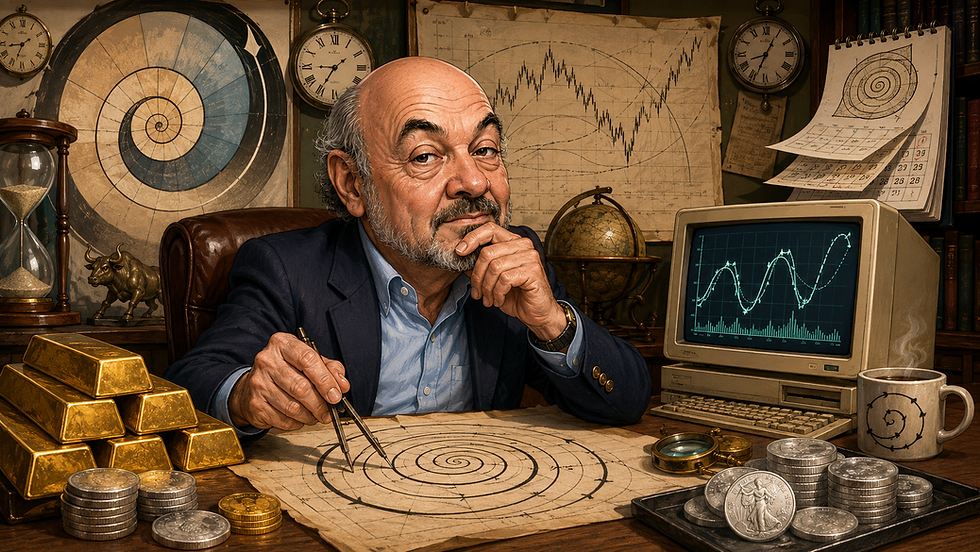
The Real Problem: Markets Are Cyclical, but Not Obedient
The strongest case for Armstrong is that markets are cyclical.
This is obviously true at a broad level. Credit expands and contracts. Governments borrow too much. Investors become euphoric and then fearful. Capital moves from one country to another. Monetary systems go through periods of trust and distrust. Empires rise and decline. Commodity markets boom and bust.
But the dangerous leap is moving from:
“Markets are cyclical”
to:
“The future can be precisely timed.”
That leap is the myth of perfect market cycles.
The myth says that if you have the right model, the right date, the right number, or the right historical rhythm, you can know when markets must turn. That myth is emotionally powerful because it reduces uncertainty. It gives investors a calendar. It turns chaos into order.
But markets do not obey calendars perfectly.
Gold can be fundamentally undervalued and still fall. Silver can be in structural deficit and still frustrate investors. A government can be fiscally reckless and still maintain a strong currency for years. A crisis can be obvious and still arrive later than expected. A cycle date can look brilliant in hindsight and useless in real time.
Healthy cycle thinking | Dangerous cycle thinking |
Markets often move in waves | The market must turn on this date |
Human behavior repeats | The model cannot be wrong |
Cycles help frame probabilities | Cycles eliminate uncertainty |
Use cycles with fundamentals | Ignore evidence that disagrees |
Prepare for scenarios | Bet everything on one forecast |
A model is a tool | A model is prophecy |
Stackers should study cycles. They should not worship them.
Gold Is a Confidence Asset, but It Is Not Magic
Gold often performs well when confidence in fiat money, government debt, or banking systems weakens. But academic research and market history show that gold’s safe-haven behavior is conditional. One study using uncertainty indexes found that gold’s hedge and safe-haven role varies depending on the type of uncertainty and the state of the gold market. Another study found that gold may hedge currency movements across different horizons, but its behavior is not uniform across all shocks.
This is the part many gold promoters ignore. Gold is not guaranteed to rise on every bad headline. During liquidity crises, investors may sell gold to raise cash. When real interest rates rise, gold can struggle because it pays no yield. When the U.S. dollar strengthens, gold can face pressure in dollar terms. When speculative positioning becomes crowded, gold can correct sharply.
Gold is powerful, but it is not mechanical.
Gold driver | Possible effect |
Falling real rates | Often supportive |
Rising real rates | Often negative |
Central-bank buying | Supportive long term |
Strong U.S. dollar | Often negative in dollar terms |
Weak fiat confidence | Supportive |
Liquidity panic | Can cause forced selling |
ETF inflows | Supportive |
ETF outflows | Negative |
Jewelry demand | Important in India and China |
Geopolitical risk | Often supportive, but not always |
A cycle model that ignores these variables is incomplete. A gold thesis that ignores cycles is also incomplete. The best approach combines both.
Armstrong’s Greatest Usefulness: Confidence and Capital Flows
The most valuable idea associated with Armstrong is not that he can predict every market to the day. It is that confidence drives capital flows.
This matters enormously.
Capital does not move only because of valuation. It moves because of trust. Investors buy government bonds when they trust the state to repay. They hold bank deposits when they trust banks. They hold fiat currency when they trust purchasing power. They buy stocks when they trust property rights and future earnings. They buy gold when they want an asset outside those promises.
Confidence condition | Possible capital movement |
Trust in government rises | Government bonds and fiat assets may benefit |
Trust in government falls | Gold, commodities, foreign assets, private assets may benefit |
Trust in banks falls | Cash, gold, T-bills, private custody may benefit |
Trust in currency falls | Gold and real assets may benefit |
Trust in private enterprise rises | Equities may benefit |
Trust in global order falls | Domestic hard assets and strategic commodities may benefit |
This is a strong framework for stackers. It helps explain why gold is not simply an inflation hedge. Gold is more accurately a confidence hedge. It often matters when trust weakens.
But confidence is not a stopwatch.
The Dangerous Part: Exact Dates and False Precision
Armstrong’s model is famous partly because of exact dates. That is what makes it exciting. It is also what makes it risky.
Exact dates create false precision. They make investors feel they know more than they do. They encourage emotional positioning. They can lead people to ignore market evidence because the model says the turn is near.
For physical stackers, this is especially dangerous. Stacking is usually a long-term strategy. It is about wealth preservation, emergency optionality, and reducing dependence on fragile systems. It should not depend on whether a model says a turn happens next month.
A stacker who buys gold because of long-term fiscal risk, currency debasement, central-bank demand, and personal risk management does not need perfect timing. A stacker who buys because a forecaster says the world changes on a specific date may be taking a psychological bet disguised as a monetary strategy.
The right question is not:
“What exact date will gold explode?”
The better questions are:
What role does gold play in my life?How much should I own?What premium am I paying?Where is it stored?What is my exit strategy?Can I hold it through volatility?
That is real stacking.
Armstrong, Socrates, and the AI Temptation
Armstrong’s Socrates system is especially interesting today because investors are fascinated by artificial intelligence. The idea of a machine that scans global data, reads capital flows, and identifies hidden turning points sounds more plausible in the AI age than it might have sounded decades ago.
But this also increases the danger.
A black-box model can become a substitute for thought. If the system is secret, outsiders cannot test it properly. If the model is always explained after the fact, failures can be reinterpreted. If followers believe the computer sees what humans cannot, skepticism weakens.
A serious investor should ask:
Question | Why it matters |
Are forecasts public and timestamped? | Prevents hindsight bias |
Are failed forecasts tracked? | Measures real reliability |
Are rules transparent? | Allows evaluation |
Is there a clear invalidation point? | Prevents endless reinterpretation |
Does the model beat simple benchmarks? | Tests usefulness |
Does it explain uncertainty? | Markets are probabilistic |
Does it encourage risk management? | Protects capital |
A model does not need to be useless to be dangerous. It only needs to be overtrusted.
What Stackers Should Learn From the Armstrong Story
The Armstrong story is valuable if stackers extract the right lessons.
Lesson One: Money carries information
Currencies, bond yields, gold premiums, capital flows, and banking stress often reveal political and economic pressure before official sources admit it.
Lesson Two: Confidence is central
Gold is not just a commodity. It is a vote on confidence. When confidence in promises weakens, gold becomes more important.
Lesson Three: Banks matter
The Republic/HSBC/Safra part of the story reminds stackers that custody, counterparties, and banking relationships matter. Gold held directly is different from claims held through institutions.
Lesson Four: Models can seduce intelligent people
The smarter the model sounds, the easier it is to overtrust. The promise of perfect timing is one of the oldest traps in markets.
Lesson Five: Legal facts and alternative narratives can coexist
The official record matters. Armstrong’s claims matter for understanding his mythology. A serious reader should examine both without blindly accepting either.
Lesson Six: Gold does not require prophecy
The case for owning gold does not depend on Armstrong, Socrates, the CIA, or a perfect cycle. It rests on monetary history, scarcity, no counterparty risk, central-bank demand, and the repeated failure of paper systems to preserve value indefinitely.
A Better Framework for Gold and Silver Stackers
Instead of asking whether Armstrong is a genius or a fraud, stackers should ask how to build a better decision framework.
Layer | Question | Why it matters |
Monetary layer | Is confidence in currency and sovereign debt rising or falling? | Gold is a confidence asset |
Market layer | What are gold and silver actually doing? | Price action matters |
Physical layer | What are premiums and supply conditions? | Stackers buy real metal, not charts |
Custody layer | Who controls the metal? | Physical control is central |
Personal layer | What role does metal play in my life? | Allocation depends on purpose |
Risk layer | What if my timing is wrong? | Prevents emotional damage |
This framework is stronger than any single cycle model because it accepts uncertainty.
For example, a cycle model may suggest a turning point, but if premiums are extreme, storage is unprepared, the buyer has no cash reserve, and gold is technically overextended, it may not be a good time for a large physical purchase.
On the other hand, even without a famous cycle date, a stacker may rationally buy when premiums are reasonable, personal finances are stable, and long-term monetary risk is rising.
That is how professionals think: not with prophecy, but with layers of evidence.
Final Verdict: Martin Armstrong Is Fascinating, but Gold Does Not Need a Prophet
Martin Armstrong’s story is one of the most fascinating stories in the hard-money world.
It has the Lebanon forecast. It has rare coins. It has the Economic Confidence Model. It has Socrates. It has the CIA claim. It has Edmond Safra, Republic National Bank, HSBC, Japanese investors, prison, missing assets, gold, antiquities, and the question of whether a computer model can see the future better than human beings.
Armstrong should be studied as a case study in confidence, capital flows, market cycles, institutional power, and the psychology of prediction. His ideas about public versus private confidence are useful. His background in coins and currencies is relevant. His story raises important questions about banks, custody, government power, and information.
But the myth of perfect cycles is dangerous.
Gold and silver stackers should study cycles, but they should not worship them. They should listen to forecasters, but never surrender judgment. They should understand confidence, but not confuse it with certainty. They should own precious metals for rational reasons, not because a secret model or dramatic story promises a perfect date.
Gold is real.
Silver is real.
Cycles are real.
But the perfect market clock is a myth.
FAQs: Martin Armstrong, Gold, and the Myth of Perfect Market Cycles
Who is Martin Armstrong?
Martin Armstrong is an American economic forecaster known for the Economic Confidence Model, a controversial cycle theory based on recurring waves of confidence and capital flows. He is also controversial because he pleaded guilty in a fraud-related case connected to Princeton Notes and served time in prison.
Why is Martin Armstrong interesting to gold and silver stackers?
Martin Armstrong is interesting to gold and silver stackers because his work focuses on currencies, confidence, sovereign debt, capital flows, gold, commodities, and historical cycles. These are the same themes that attract many people to physical precious metals.
What is the story about Martin Armstrong predicting the Lebanon War?
According to Armstrong, an early model built from historical Lebanese currency data projected a critical collapse point on June 6, 1982. That was the date Israel launched the First Lebanon War. The war date is historically established, but the forecast story itself is mainly known from Armstrong’s own account.
What is the Economic Confidence Model?
The Economic Confidence Model is Armstrong’s cycle model based around an 8.6-year wave, or roughly 3,141 days. Armstrong presents it as a model of global confidence and capital flows rather than a direct trading model for one asset.
Does Armstrong’s Economic Confidence Model directly predict gold?
Armstrong has argued that the model should not be understood as a simple gold model. It is better described as a confidence and capital-flow model, which may affect gold but does not mechanically predict gold alone.
What is Socrates in Martin Armstrong’s story?
Socrates is the name associated with Armstrong’s computer forecasting system. His supporters view it as a powerful model for analyzing global capital flows, market cycles, and political-economic turning points.
Did the CIA really want Martin Armstrong’s computer?
Armstrong has claimed that the CIA wanted him to build a computer model for them after his system anticipated major global events. This is central to his version of the story, but it is not independently proven in the same way as the official legal record.
What is the Safra connection in the Martin Armstrong case?
The Safra connection involves Republic National Bank, Edmond Safra’s banking empire, HSBC’s acquisition of Republic and Safra Republic Holdings, Japanese investor litigation, and allegations involving Princeton Notes. The banking and litigation connections are documented, while Armstrong’s interpretation of Safra’s role remains disputed.
How was HSBC connected to the Armstrong case?
HSBC acquired Republic New York Corporation and Safra Republic Holdings at the end of 1999. Later reporting described legal exposure involving Japanese investors, Republic, HSBC, and allegations tied to Armstrong and Princeton Notes.
Why did Martin Armstrong go to prison?
Armstrong went to prison after a legal case involving fraud allegations connected to Princeton Notes and investor losses. He also spent years jailed for civil contempt related to court demands that he turn over assets the court believed he controlled.
Was Martin Armstrong convicted of fraud?
Armstrong pleaded guilty in 2006 to conspiracy involving securities fraud, commodities fraud, and wire fraud. That is part of the official legal record.
Why do Armstrong’s supporters say the case was really about his model?
Armstrong’s supporters argue that the real target was his Socrates computer system and forecasting methodology. They believe powerful institutions wanted access to the model. This is a major part of Armstrong’s mythology but is not proven as the official cause of the prosecution.
Why does Armstrong’s prison story appeal to precious-metals investors?
The prison story appeals to precious-metals investors because it involves distrust of banks, governments, fiat systems, and official narratives. It fits the hard-money worldview of a forecaster punished after challenging powerful institutions.
What should stackers be careful about when studying Armstrong?
Stackers should separate documented facts from Armstrong’s own claims and supporter narratives. His ideas may be interesting, but his legal history and the unverified parts of the story require caution.
Is Martin Armstrong a reliable market prophet?
No forecaster should be treated as a prophet. Armstrong may offer useful ideas about confidence and capital flows, but investors should not treat any model as a perfect market clock.
Why do gold investors like market-cycle theories?
Gold investors like market-cycle theories because gold is deeply connected to history, currency cycles, debt crises, inflation, government credibility, and financial stress. Cycle theories seem to offer structure in a chaotic monetary world.
Are market cycles real?
Yes, markets often move in cycles because human behavior, credit expansion, leverage, fear, greed, and policy mistakes repeat. But real cycles are not perfectly mechanical.
What is the myth of perfect market cycles?
The myth of perfect market cycles is the belief that markets can be predicted with exact timing through a single model, number, or date. This belief can be dangerous because it creates false certainty.
Why is exact-date forecasting dangerous?
Exact-date forecasting can cause investors to over-position, ignore contrary evidence, and treat a model as prophecy. If the date fails, followers may reinterpret events instead of reassessing the model.
How does gold relate to confidence?
Gold relates to confidence because it becomes more attractive when people lose trust in currencies, banks, government debt, or central banks. Gold is not another party’s liability, which gives it a special role during confidence crises.
Is gold always a safe haven?
No. Gold can act as a safe haven in some conditions, but not always. It can fall during liquidity crises, periods of rising real interest rates, or strong U.S. dollar environments.
Why does silver behave differently from gold?
Silver behaves differently because it is both a precious metal and an industrial metal. It is affected by monetary demand, investor demand, solar demand, electronics demand, mining supply, and general economic activity.
Is silver harder to predict than gold?
Yes. Silver is often harder to predict because it has more industrial exposure and tends to be more volatile than gold. It can behave like money, a commodity, or a speculative risk asset depending on the environment.
What can stackers learn from Armstrong without blindly following him?
Stackers can learn that confidence matters, capital flows matter, currency stress can reveal political risk, and history often moves in waves. But they should not rely on any single forecaster or model.
Does gold need Martin Armstrong’s model to be worth owning?
No. Gold does not need Armstrong’s model to be worth owning. The case for gold can rest on scarcity, monetary history, central-bank demand, lack of counterparty risk, and long-term currency debasement.
What is the best way to use cycle analysis in precious-metals investing?
The best way to use cycle analysis is as one input among many. Stackers should also consider premiums, storage, liquidity, taxes, real rates, central-bank demand, personal finances, and risk tolerance.
What is the difference between studying Armstrong and believing Armstrong?
Studying Armstrong means examining his ideas, history, claims, and controversies critically. Believing Armstrong means accepting his model or personal narrative without enough independent verification.
Why is custody important in the Armstrong story?
Custody is important because the Armstrong story involves banks, managed accounts, assets, records, and control. For stackers, it reinforces the difference between owning physical metal directly and relying on financial intermediaries.
What is the most important lesson from Martin Armstrong for gold and silver stackers?
The most important lesson is that confidence drives markets, but confidence cannot be timed perfectly. Stackers should study cycles, but they should not worship them.
What is the final verdict on Martin Armstrong and gold?
Martin Armstrong is a fascinating and controversial figure whose ideas about confidence and capital flows are relevant to gold investors. But the myth of perfect market cycles is dangerous, and stackers should never replace independent judgment with faith in a model.


Comments