


Why Did Governments Remove Silver From Coins? The Complete History of Silver Coin Money

For most of human history, silver was not an investment product. It was money.
People did not buy silver because they expected a financial influencer to predict a price target. They used silver because it was divisible, durable, recognizable, scarce enough to hold value, but common enough to circulate in daily trade. For thousands of years, silver occupied the middle ground between copper and gold. Copper was useful for small transactions. Gold was useful for large wealth storage. Silver was the metal of wages, savings, taxes, trade, and everyday commerce.
That world is now almost completely gone.
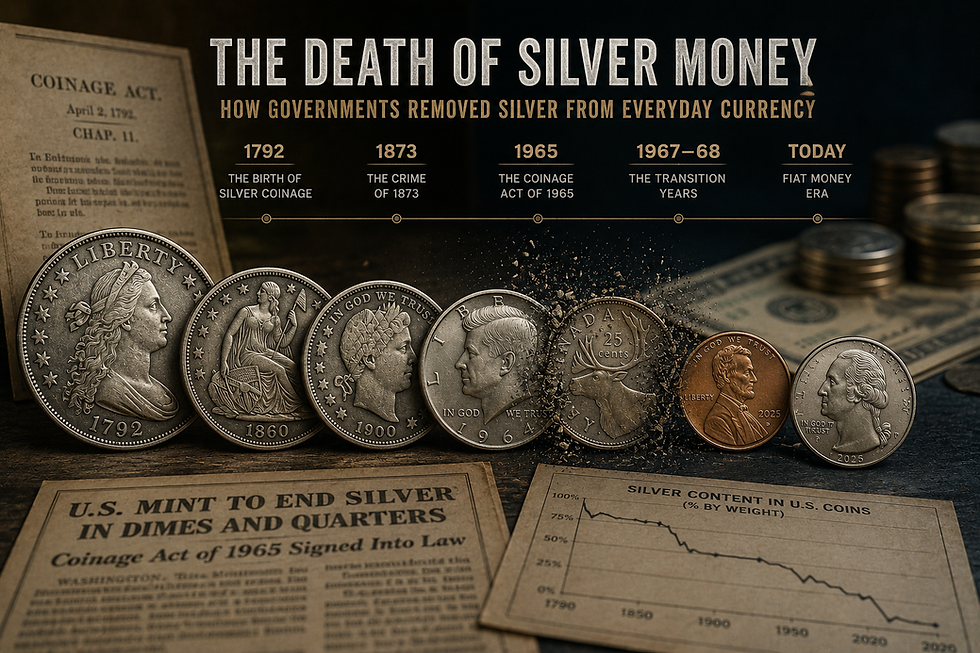
Modern coins still look metallic, but most circulating coins are no longer made from precious metal. The average dime, quarter, pound coin, euro coin, Canadian quarter, or Australian 50-cent piece is no longer a piece of money with intrinsic value. It is a token. Its value comes from law, public trust, and the monetary system behind it, not from the metal inside it.
The removal of silver from coinage was not an accident. It was one of the most important monetary transitions of the modern age. Governments removed silver from coins because the face value of the coins could no longer support the market value of the silver inside them. When the metal in a coin becomes worth more than the coin’s legal value, people stop spending the coin. They hoard it, melt it, export it, or sell it as bullion. At that point, the coin stops functioning as money.
This is the history of how silver money died.
Silver Was Once the People’s Money
Gold has always carried prestige, but silver was more practical for daily life. A gold coin could represent a large amount of wealth, but that made it inconvenient for ordinary transactions. Silver was different. It could be struck into coins small enough for daily purchases but valuable enough to store meaningful savings.
That is why silver became deeply embedded in monetary systems across the world. The Spanish silver dollar, also known as the piece of eight, circulated across Europe, Asia, and the Americas. The U.S. dollar itself was built around silver. The Coinage Act of 1792 established the U.S. Mint and defined the dollar through precious metal coinage; the U.S. Mint’s historical text lists the silver dollar as containing 371.25 grains of pure silver, or 416 grains of standard silver.
This detail matters. The original U.S. dollar was not simply a paper unit declared by government. It was a specific weight of silver. Money was measured by metal.
That system worked when the legal value of a coin and the market value of its metal were close enough to remain stable. But the system became fragile whenever metal prices moved. If silver became too cheap relative to gold, silver flooded the system. If silver became too expensive relative to the coin’s face value, silver coins disappeared from circulation.
The death of silver coinage began when governments could no longer keep that balance.
The First Break: The “Crime of 1873”
The United States did not remove silver from pocket change in one step. The first major break came with the Coinage Act of 1873, later attacked by silver supporters as the “Crime of 1873.”
The U.S. Mint explains that the consequences of the 1873 act became so controversial that it earned that nickname. The central issue was that the law ended the free coinage of the standard silver dollar, moving the United States toward a gold-standard system by default.
This was not the same as removing silver dimes and quarters from circulation. Smaller silver coins still existed. But the political meaning was enormous. Silver was no longer treated as equal monetary foundation with gold. The country was moving away from bimetallism.
The controversy became especially intense because silver production was rising in the American West. Miners, farmers, and debtors often supported silver because expanding silver coinage could increase the money supply and ease debt burdens. Creditors and financial interests tended to prefer gold because it was seen as more stable and restrictive.
This is why silver became political. The debate was not just about coins. It was about who benefits from tight money and who benefits from easier money.
Why Silver Coins Become Impossible to Maintain
A silver coin works only while its bullion value stays below or near its face value. If a quarter contains 25 cents of silver, it can circulate normally. If it contains 40 cents of silver, rational people will not spend it as 25 cents. They will remove it from circulation.
This is known as Gresham’s Law: bad money drives out good money when both are legally valued the same. In practice, people spend the overvalued token money and save the undervalued real-metal money.
This is exactly what happened in the twentieth century. Industrial demand for silver increased. Government silver reserves were not unlimited. Inflation reduced the purchasing power of paper currency. Eventually, silver coins became too valuable to circulate at face value.
The result was predictable. Governments faced a choice:
They could raise the face value of silver coins, reduce the silver content, replace silver with base metals, or allow coin shortages to worsen.
Most governments chose debasement first and full removal later.
The United States: The Coinage Act of 1965
The most important modern example is the United States.
Before 1965, U.S. dimes, quarters, half dollars, and earlier silver dollars were traditionally struck in 90 percent silver. These coins were not symbolic silver. They contained real silver in meaningful amounts. A pre-1965 U.S. quarter contains about 0.1808 troy ounces of silver. A pre-1965 dime contains about 0.0723 troy ounces. A pre-1965 half dollar contains about 0.3617 troy ounces.
By the early 1960s, this system was breaking. Silver prices were rising, coin shortages were spreading, and the Treasury’s silver stockpile was being drained. The Coinage Act of 1965 removed silver from circulating dimes and quarters and reduced the half dollar from 90 percent silver to 40 percent silver. The U.S. Mint notes that the new half dollar had outer layers of 80 percent silver but a core containing 21 percent silver, producing an overall silver content of 40 percent.
The official reasoning was practical. President Lyndon Johnson argued that silver needed by industry should not be wasted in everyday coinage and that the country needed a stable supply of coins. Contemporary accounts of the act describe coin shortages beginning in 1959 and note that smaller silver coins became attractive for melting once silver rose above roughly $1.38 per ounce.
That number is shocking today. A silver price above $1.38 per ounce was enough to threaten the economics of U.S. coinage. In the modern era, silver has traded many multiples above that level. At current-type silver prices, the bullion value of old 90 percent silver coins can be many times their face value.
The public understood this quickly. Silver coins vanished from circulation because people saved them. The government could change the coins, but it could not force people to treat old silver coins as ordinary change once the metal value was obvious.
The Kennedy Half Dollar and the Last Silver Circulating Coins
The Kennedy half dollar tells the story perfectly.
In 1964, the Kennedy half dollar was 90 percent silver. From 1965 through 1970, it was reduced to 40 percent silver. After that, regular circulating half dollars lost their silver content.
This gradual removal shows that governments often debase in stages. They do not always remove precious metal overnight. They may reduce the content first, observe market behavior, and then complete the transition.
The result was that silver disappeared from normal American pocket change. Pre-1965 dimes and quarters became “junk silver,” a term that sounds negative but actually means common-date silver coins valued mainly for metal content rather than rare numismatic premium.
For stackers, junk silver remains important because it is fractional, recognizable, and historically trusted. It is a direct remnant of the old monetary system.
Silver Certificates: Paper Claims Without Silver Redemption
Coins were only one part of the silver story. The United States also issued silver certificates, paper notes that once represented a claim on silver.
That redemption link ended in 1968. The U.S. Mint’s historical documents state that the Treasury published procedures for exchanging silver certificates for silver bullion and that the exchange period ended on June 24, 1968. After that date, silver certificates remained legal tender but were no longer redeemable for silver.
This was another major step in the death of silver money. The paper note survived. The metal claim disappeared.
That pattern appears repeatedly in monetary history. Governments often preserve the familiar form of money while removing the intrinsic backing behind it. The public still sees a dollar, a certificate, a coin, or a banknote. But the legal relationship between the currency and the metal changes.
The United Kingdom: From Sterling Silver to Cupro-Nickel
Britain’s silver removal happened earlier and in stages.
For centuries, British silver coins were made from sterling silver, meaning 92.5 percent silver. After the First World War, the cost of maintaining that standard became difficult. In 1920, Britain reduced most circulating silver coins from sterling silver to 50 percent silver. Specialist summaries of British coinage describe this as a reduction from 92.5 percent to 50 percent silver.
The second stage came after the Second World War. The Royal Mint Museum explains that the Coinage Act 1946 introduced cupro-nickel coinage, with new cupro-nickel coins dated 1947 and issued to banks from January 2.
This was the end of silver in ordinary British circulating coinage.
The British case is important because it shows how war accelerates monetary debasement. The First World War weakened the old sterling silver standard. The Second World War finished it. Precious metals were too valuable to leave in low-denomination coins when the state faced debt, reconstruction costs, and pressure on reserves.

Canada: The 1967–1968 Silver Transition
Canada followed a pattern similar to the United States but with its own timeline.
Canadian quarters were once sterling silver, later 80 percent silver, and then reduced again. The Royal Canadian Mint’s specifications for the 25-cent coin show that Canadian quarters were 80 percent silver and 20 percent copper through 1967, then 50 percent silver and 50 percent copper in the 1967–1968 transition period, and then 99.9 percent nickel from 1968 to 1977.
The Canadian dime followed the same broad path. The Royal Canadian Mint states that 1967 marked a reduction in Canadian coinage from 80 percent silver to 50 percent, with the composition changing further to nickel in 1968.
Canada’s transition years are famous among coin roll hunters because some coins from 1967 and 1968 may contain silver while others do not. That is what happens when a country changes metal standards in real time. The boundary between money and bullion becomes visible in ordinary pocket change.
Australia: The 1966 Round 50-Cent Coin
Australia offers one of the cleanest examples of silver disappearing because the metal value overtook the face value.
Australia introduced decimal currency on February 14, 1966. The original round 50-cent coin was struck in 80 percent silver. The Royal Australian Mint explains that the original 50-cent design featured the Commonwealth Coat of Arms on an 80 percent silver coin, but as the silver price rose above the coin’s face value, the Mint suspended striking of the coin in March 1968.
This is the whole story of silver coinage in one sentence: the metal became worth more than the money.
Australia did not need a philosophical debate to prove the point. A 50-cent coin containing 80 percent silver could not survive as a circulating coin if its bullion value exceeded 50 cents. People would hoard it. The Mint would lose money producing it. The coin would disappear from commerce.
Today, the 1966 round 50-cent coin is a popular bullion and collector item precisely because it failed as a token coin. It was too real to remain ordinary money.
The Pattern Around the World
The same pattern appeared across many countries.
Governments first used silver because it gave coins intrinsic value and public trust. Then, as economies grew and paper money expanded, silver became inconvenient. Industrial demand rose. Prices fluctuated. Wars and welfare states increased government spending. Inflation reduced the real value of face denominations. Eventually, silver coins became too expensive to produce and too valuable to circulate.
The response was nearly universal: reduce silver content, replace silver with copper-nickel or nickel, and preserve the old denominations in cheaper metal.
This means the death of silver money was not caused by one law or one country. It was a global monetary transition.
The Economics of Debasement
Debasement has a negative reputation, but governments usually describe it as modernization.
From the government’s perspective, removing silver solves several problems. It reduces production costs. It prevents coin shortages. It protects silver reserves. It allows coin supply to expand without being limited by precious metal availability. It also creates seigniorage, the difference between the face value of money and the cost of producing it.
From the citizen’s perspective, the story is more complicated. A silver quarter and a clad quarter may both pay 25 cents legally, but they are not the same asset. One has metal value independent of the issuing government. The other depends almost entirely on monetary trust.
This is why stackers view silver removal as a quiet wealth transfer. The public was moved from intrinsic-value money into token money. The nominal unit stayed the same, but the substance changed.
What Happened After Silver Was Removed?
Once silver was removed, old silver coins disappeared from circulation. This was not because people forgot about them. It was because they understood the difference between a silver coin and a base-metal coin.
In the United States, pre-1965 silver dimes and quarters were quickly pulled from circulation by the public. In Britain, pre-1947 coins became bullion items. In Canada, silver dimes and quarters became targets for coin roll hunters and stackers. In Australia, the 1966 round 50-cent coin became famous because its silver value exceeded face value.
The disappearance of silver coins proves that ordinary people are not as financially ignorant as policymakers sometimes assume. When given a choice between spending a token coin and saving a silver coin of the same face value, people save the silver.
Why Silver Did Not Return to Circulation
Once silver left circulating coins, it never returned in any serious way.
The reason is simple: modern monetary systems require flexible, low-cost token coinage. Governments want coins to function as small change, not as miniature bullion products. If silver returned to circulating coins, the same problem would reappear. Rising silver prices would cause hoarding, shortages, and melting.
Silver still appears in commemorative coins, bullion coins, and collector issues. But those coins are usually sold above face value. They are not designed to circulate at their legal denomination. A one-ounce silver coin may have a face value of one dollar, five dollars, or another symbolic amount, but no rational person spends it for that amount when the silver content is worth far more.
That distinction is crucial. Silver still exists in coin form, but it no longer functions as everyday money.
Could Silver Ever Become Money Again?
Silver could return as a private savings asset, barter asset, or parallel store of value. But a full return to silver circulating coinage is unlikely under modern monetary systems.
There are three reasons.
First, the value density of silver is lower than gold. Large amounts of wealth in silver require significant weight and storage space.
Second, silver has major industrial uses. Its price is influenced not only by monetary demand but also by solar panels, electronics, medical uses, and manufacturing.
Third, governments prefer monetary flexibility. A silver coin standard limits the ability to expand money supply, manage interest rates, and finance deficits through fiat currency.
That does not mean silver is irrelevant. It means silver’s modern role is different. It is no longer the coin of daily commerce. It is a hedge against the weaknesses of the system that replaced it.
The Real Lesson for Stackers
The removal of silver from coinage teaches one major lesson: when the intrinsic value of money conflicts with government monetary policy, governments usually choose policy.
They do not preserve silver coinage at all costs. They change the coinage.
That does not make every government evil or every reform a conspiracy. In many cases, officials were responding to real shortages, real metal-price pressures, and real production constraints. But the outcome was still the same. Citizens lost access to circulating money with intrinsic precious-metal value.
For stackers, this history explains why old silver coins remain attractive. They are not just collectibles. They are physical evidence of a monetary world that no longer exists.
A pre-1965 U.S. quarter, a pre-1947 British florin, a Canadian 80 percent silver quarter, or an Australian 1966 round 50-cent coin is more than old change. It is a reminder that money used to be metal, not just a number.
Final Verdict
Governments removed silver from coins because silver became too valuable for the denominations it was supposed to represent.
The process was gradual but global. The United States removed silver from dimes and quarters in 1965. Britain reduced silver in 1920 and removed it from ordinary coinage in 1947. Canada transitioned out of silver in 1967–1968. Australia’s 1966 round 50-cent coin disappeared because its silver value exceeded its face value.
The common thread is clear. When silver coins became worth more as metal than as money, they stopped working as circulating currency.
That is the death of silver money: not a single event, but a long global shift from intrinsic-value coinage to government-issued token money.
And for anyone who stacks silver today, that history is not just interesting. It is the reason silver still matters.
FAQ: The Death of Silver Money
Why did governments remove silver from coins?
Governments removed silver from coins because the market value of the silver eventually became greater than the coin's face value. When this happens, people stop spending the coins and begin hoarding, melting, or selling them for their silver content, creating coin shortages and increasing minting costs.
When did the United States stop putting silver in coins?
The United States removed silver from dimes and quarters through the Coinage Act of 1965. Half dollars retained reduced silver content until 1970 before transitioning to copper-nickel compositions.
Why did the United States remove silver from dimes and quarters in 1965?
Rising silver prices and growing industrial demand made silver coinage increasingly expensive. The government believed removing silver would reduce coin shortages and allow for a more stable supply of circulating currency.
What was the Coinage Act of 1965 and how did it affect silver coins?
The Coinage Act of 1965 eliminated silver from U.S. dimes and quarters and reduced the silver content of half dollars from 90% to 40%. It marked the beginning of the end for silver in everyday American coinage.
What percentage of silver was contained in U.S. coins before 1965?
Most U.S. dimes, quarters, half dollars, and silver dollars minted before 1965 contained 90% silver and 10% copper.
How much silver is in a pre-1965 U.S. quarter?
A pre-1965 U.S. quarter contains approximately 0.1808 troy ounces of silver, making it significantly more valuable than its face value when silver prices rise.
How much silver is in a pre-1965 U.S. dime?
A pre-1965 U.S. dime contains approximately 0.0723 troy ounces of silver and is one of the most commonly collected junk silver coins.
What is junk silver and why is it popular among silver stackers?
Junk silver refers to common circulated silver coins valued primarily for their silver content rather than collectible rarity. Many investors like junk silver because it is recognizable, divisible, and often carries lower premiums than modern bullion products.
What happened to silver coins after silver was removed from circulation?
Most silver coins gradually disappeared from circulation because people recognized that the metal inside them was worth more than their face value. Millions were saved, hoarded, melted, or sold as bullion.
Why are pre-1965 silver coins worth more than their face value today?
The silver content in these coins is worth substantially more than their original denomination. Their value is determined primarily by the current market price of silver rather than the face value stamped on the coin.
What is Gresham's Law and how did it affect silver coins?
Gresham's Law states that bad money drives good money out of circulation when both are accepted at the same face value. As silver coins became more valuable than clad coins, people spent the cheaper coins and saved the silver ones.
What happened to silver certificates in the United States?
Silver certificates were paper notes that could once be redeemed for physical silver. In 1968, the U.S. government ended silver redemption, severing the connection between silver certificates and physical silver.
Why did silver disappear from everyday money around the world?
Most countries removed silver from coinage because rising silver prices made precious-metal coins too expensive to circulate. Governments replaced silver with cheaper metals such as nickel, copper, and copper-nickel alloys.
When did the United Kingdom remove silver from circulating coins?
Britain reduced silver content from sterling silver to 50% silver in 1920 and completely removed silver from most circulating coins beginning in 1947.
When did Canada stop using silver in coins?
Canada transitioned away from silver between 1967 and 1968. During this period, some coins contained reduced silver content before eventually being replaced with nickel-based coinage.
Why is the 1966 Australian round 50-cent coin famous among silver investors?
The original Australian round 50-cent coin contained 80% silver. Rising silver prices pushed its bullion value above its face value, causing it to disappear from circulation and become highly sought after by collectors and investors.
What was the Crime of 1873 and why is it important to silver investors?
The Crime of 1873 refers to the Coinage Act of 1873, which ended the free coinage of silver dollars in the United States. Critics argued that the law effectively demonetized silver and pushed America toward a gold-standard monetary system.
How did the removal of silver from coins change the monetary system?
The removal of silver transformed money from a precious-metal-based system into a token currency system where coins derive their value from government decree rather than intrinsic metal content.
What is debasement and how does it relate to silver coinage?
Debasement occurs when a government reduces the precious-metal content of a coin while maintaining the same face value. Throughout history, silver coinage was often debased before silver was removed entirely.
Why do silver stackers prefer old silver coins over modern coins?
Many silver stackers value old silver coins because they contain real precious metal, have a long history of circulation, are widely recognized, and provide a tangible connection to historical monetary systems.
Could silver ever return to everyday circulating coinage?
A return to silver circulating coins is unlikely because modern governments prefer low-cost coin production and flexible monetary systems. Rising silver prices would quickly create the same hoarding problems that led to silver's removal in the first place.
Why do silver coins matter to investors today?
Silver coins provide historical evidence of how money once functioned as a store of value rather than a token currency. Many investors view them as a hedge against inflation, currency debasement, and financial uncertainty.
What is the biggest lesson from the death of silver money?
The biggest lesson is that when the intrinsic value of a coin becomes greater than its face value, governments typically change the coin rather than increase its denomination. This pattern has repeated throughout monetary history across many countries.


Comments